Have any question?
Call (240) 226-7055

Call (240) 226-7055


If you’ve talked to a software vendor in the past decade or so, you’ve probably heard a pretty consistent pitch for the cloud: your access will be seamless, you’ll have nothing to maintain, there’s no limit to what you can do! Unfortunately, this isn’t necessarily the case. If either your business or the cloud provider experiences an outage, for instance, all these benefits evaporate. Your business is, for all intents and purposes, closed until the problem is solved.
Enter the local database, a practical and efficient way to overcome this weakness.

Workplace friction rarely happens overnight. More often than not, it results from small, unchecked daily annoyances that build up over time. When team members struggle to communicate or feel their daily workflow is constantly impeded, productivity stalls and frustration takes over.
Resolving this tension requires a clear strategy to address issues early and set straightforward expectations across your organization.

When daily operations slow down and margins shrink, business owners usually look straight at payroll or marketing expenses. However, hidden software subscriptions and aging hardware are far more likely to be the silent productivity killers in your office.
Technology should remove friction from your workday, not create it. Cleaning up your technology stack is one of the fastest ways to eliminate operational bottlenecks, secure your data, and give your team hours back every single week.
When your team members are trying to hit tight deadlines, they want the path of least resistance. Often, that means saving critical files to their local desktop or a personal cloud account to avoid network latency or deep folder hierarchies.
It seems harmless on the surface. However, storing company information on local drives creates major operational risks for your business.

Most small business owners assume their company is too small to attract active hackers. In reality, cybercrime relies on automated tools scanning for open vulnerabilities rather than specific brand names. Leaving your network unsecured guarantees your systems will eventually be discovered.

An email arrives from your CEO requesting an urgent, off-schedule wire transfer to secure a vendor deal. Standard operational caution gives way to speed, and cash is redirected to an unauthorized account.
This is the result of a form of cyberattack known as business email compromise. Let’s discuss how to stop it.

Cybersecurity Awareness Month serves as a vital reminder that technical infrastructure relies heavily on human habits. A single compromised credential can expose your entire network to unauthorized access and operational downtime. Protecting company data is a shared organizational responsibility.

When remote team members deal with application freezes and dropped voice calls, daily operations suffer immediately. These disruptions stem from unoptimized home internet routing and improper VPN configurations, not poor employee performance. Fixing these network bottlenecks protects productivity and maintains business stability.

Most business owners view technology as just another utility bill to keep as low as possible. However, when sluggish hardware and broken software cost your team twenty minutes every day, you quietly lose billable hours. Neglecting your technology stack does not save money; it puts a continuous, unrecorded tax on your payroll.

We’ve all been there. You are staring at your screen, something isn't working right, and you hesitate to ask for help because you think your question sounds silly.
Today is Ask a Stupid Question Day, and I am here to tell you that in the world of business technology, keeping quiet is the only actual mistake you can make.

Running a business keeps you busy, making it easy for tech blind spots to quietly sneak up on your operations.
The good news? Fixing the most common technology mistakes doesn't require a massive budget—just a few simple adjustments.

Investing in business technology support does not render a network completely immune to disruptions. Software updates alter configurations overnight, cloud vendors experience outages, and minor operational mistakes happen. Unfortunately, complete immunity from technical issues is impossible.
The good news is that proactive IT management drastically changes how and how often those disruptions affect your daily workflow.
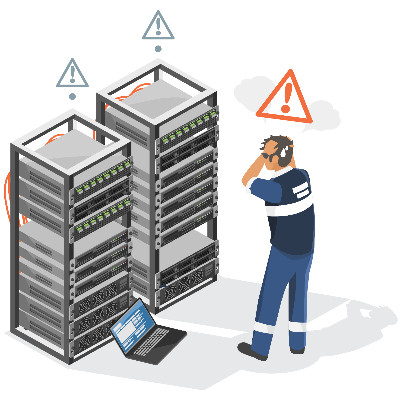
When a central server fails, daily business operations grind to an immediate halt. Most business owners take comfort in knowing a nightly backup runs in the background. However, having raw files saved on an offsite drive is only half of the equation when unexpected downtime strikes your network.

Running a business at maximum output sounds great on paper. You look at activity dashboards, measure response times, and try to extract every single percentage point of efficiency out of your daily operations.
Setting expectations to maximum capacity indefinitely creates a fragile organization. High productivity targets sound like good management, but squeezing every ounce of energy from your staff actively damages worker retention, creates artificial output, and weakens your company culture.

Many organizations continue running legacy software versions long past their official manufacturer support dates because the applications still execute basic daily tasks. That said, operating unpatched systems introduces severe security vulnerabilities that automated malware scans actively target.
Failing to modernize your business’ software leaves your corporate data exposed to unauthorized access and system-wide failure. Let’s talk about how to shore up these vulnerabilities.
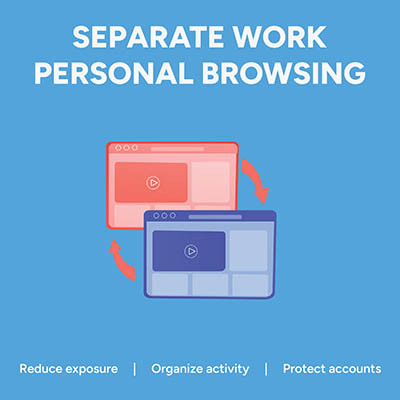
Picture this: an employee is logged into their personal Google or Microsoft account to check a personal email. In the very next tab, they open your company's cloud dashboard to edit a sensitive spreadsheet. It feels completely harmless, but in reality, that single overlapping browser session is a quiet source of data leaks, compliance headaches, and constant calls to your IT help desk.
That’s because if personal identities and corporate cloud accounts mingle in the same browser instance, the browser gets confused. It attempts to sync saved passwords, autofill data, browsing history, and extension permissions across both environments.
The fix is simple… enforce dedicated browser profiles for your entire team.

Navigating a cyber insurance policy renewal used to involve answering a few straightforward questions about your basic antivirus software. Today, insurance underwriters require detailed evidence of comprehensive security controls before they will even consider approving your coverage.

Managing hundreds of business accounts with complex, frequently changed passwords no longer protects your organization. In fact, forcing arbitrary symbol substitutions and constant resets creates predictable patterns that hackers easily exploit. Modern security relies on practical, long-term rules that safeguard data without slowing down daily work.

Moving your company files into cloud storage like Microsoft OneDrive or Google Drive is a huge milestone, but without basic folder rules, it quickly turns into digital chaos. Searching for misplaced files drains hours of staff productivity. Simple file rules fix that fast.

When cybercriminals try to break into a business, they rarely bother picking digital locks. Instead, they send a convincing email straight to someone on your staff. Treating your team like a security liability creates fear and keeps people from reporting suspicious activity.
Our network audit will reveal hidden problems, security vulnerabilities, and other issues lurking on your network.
Learn more about what C3-Solutions can do for your business.
C3-Solutions
300 Kerby Hill Rd
Fort Washington, Maryland 20744